




Last Updated: October 31, 2026
Quick Summary
You can manage knee pain at home by starting with rest, ice, compression, and elevation, often called the R.I.C.E. method. Ice for 15-20 minutes several times a day, wrap the knee with an elastic bandage for light support, and prop the leg above heart level.
- Ice is best for a fresh injury or swollen, hot knee, while heat suits stiff, achy joints.
- Never place ice directly on bare skin or leave it on for more than 20 minutes.
- Do knee exercises like quad sets, straight-leg raises, heel slides, and sit-to-stand three to four times a week.
- For a twisted knee, follow R.I.C.E. right away and add gentle movement as pain fades.
- See a doctor if you cannot bear weight, the knee locks or gives way, or pain lasts more than a few weeks.
Table of Contents
- Start With Rest, Ice, Compression, and Elevation
- Ice or Heat for Knee Pain: Which One Helps?
- Knee Pain Exercises at Home to Build Strength
- How to Treat a Twisted Knee at Home
- Frequently Asked Questions
Start With Rest, Ice, Compression, and Elevation
Most knee pain settles fastest when you give the joint a break and calm the swelling first. Joint pain often settles without pills, and the starting point is usually rest, ice, compression, and elevation, often called the R.I.C.E. method.
Here is how to manage knee pain at home with those four steps:
- Rest: Cut back on the activity that hurts. Avoid full bed rest, since gentle movement helps healing.
- Ice: Apply an ice pack wrapped in a towel for 15-20 minutes, several times a day.
- Compression: Use an elastic bandage for light support. It should feel snug, never tight.
- Elevation: Prop the leg on pillows so the knee sits above heart level.
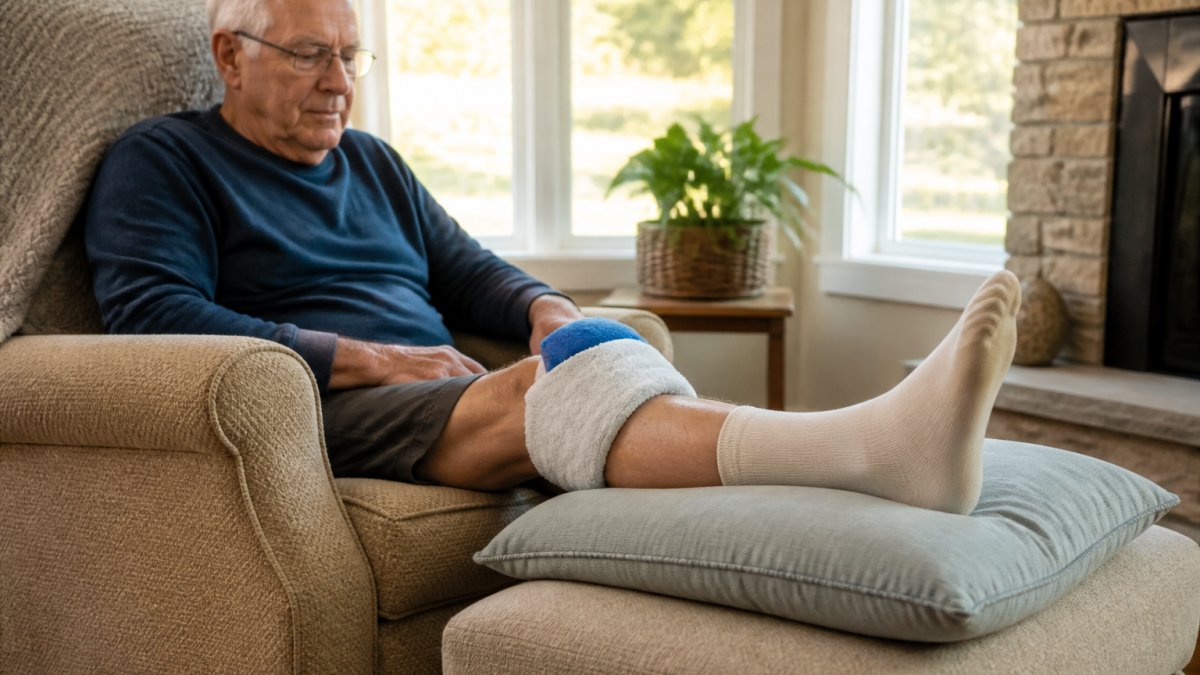
Watch out: Never place ice directly on bare skin or leave it on for more than 20 minutes. That can damage the skin and nerves.
If your knee pain comes from arthritis, drug-free therapy can be part of a broader approach to comfort. Our arthritis pain relief devices use gentle vibration.
The R.I.C.E. method is the starting point for most knee pain at home.
Step |
What to do |
Key detail |
|---|---|---|
Rest |
Cut back on the activity that hurts |
Avoid full bed rest; gentle movement helps healing |
Ice |
Apply an ice pack wrapped in a towel |
15-20 minutes, several times a day |
Compression |
Use an elastic bandage for light support |
Should feel snug, never tight |
Elevation |
Prop the leg on pillows |
Knee sits above heart level |
Ice or Heat for Knee Pain: Which One Helps?
Ice is best for a fresh injury or a swollen, hot knee. Heat is better for stiff, achy joints, especially arthritis pain. A simple rule: ice calms inflammation in the first 48 hours, and heat loosens things up after that.
For ice or heat for knee pain, timing matters more than people think:
- Ice for 15-20 minutes at a time, with at least an hour between sessions.
- Use a warm pack or heating pad for 15-20 minutes to ease stiffness before activity.
- Always wrap the pack in a cloth. Never sleep on a heating pad.
If you want targeted relief at home, our targeted heat and cyclo-therapy vibration pad combines heat with gentle vibration. Curious how it works? Read how vibration therapy works to see what gentle therapeutic vibration may do for pain and stiffness.

Knee Pain Exercises at Home to Build Strength
Strong muscles protect the knee and take pressure off the joint. The best knee pain exercises at home are simple, low-impact moves you can do in a chair or on the floor. Start slow, and stop any move that causes sharp pain.
Targeted Heat + Cyclo-Therapy vibration for Deep Pain Relief →
Try these three to four times a week:
- Quad sets: Sit with the leg straight. Tighten the thigh muscle and press the back of the knee down. Hold 5 seconds. Do 10 reps.
- Straight-leg raises: Lie down, keep the leg straight, and lift it about 12 inches. Hold 3 seconds. Do 10 reps.
- Heel slides: Lie on your back and slide the heel toward your buttocks, bending the knee as far as comfortable. Do 10 reps.
- Sit-to-stand: Rise slowly from a chair without using your hands. Do 8-10 reps.
Low-impact activity like swimming, water aerobics, or an exercise bike can also be a gentler way to keep moving. If you want to support recovery alongside exercise, you can browse drug-free therapy devices built for muscle recovery.
How to Treat a Twisted Knee at Home
Many mild twists improve with home care, though recovery time varies. To treat a twisted knee at home, follow R.I.C.E. right away, protect the knee from further strain, and add gentle movement as the pain fades.
Here is a simple plan:
- First 48 hours: Rest, ice every few hours, wrap with an elastic bandage, and elevate.
- Days 3-7: Keep icing after activity, and start gentle range-of-motion moves.
- Week 2 and beyond: Add light strengthening, and return to normal activity slowly.
For safe medication use, over-the-counter pain relievers like acetaminophen or ibuprofen can ease pain. Check with a doctor first if you take other medicines or have stomach, kidney, or heart conditions.
When to see a doctor for knee pain: Get medical care if you cannot bear weight, the knee locks or gives way, swelling is severe, or pain lasts more than a few weeks. Seek urgent help for a hot, red, swollen knee with fever.
If you are using a therapy device during recovery, you can review usage guidance on our common questions page.
Frequently Asked Questions
Can walking make knee pain worse?
Walking can help or hurt depending on how you do it. Short, gentle walks on flat ground keep the joint moving. Long walks, hills, or pushing through sharp pain can aggravate the knee. If walking causes swelling or pain that lasts more than an hour afterward, cut back. Swap in low-impact exercise like swimming or an exercise bike until the knee settles, and use rest and activity modification to protect the joint.
How long should I rest a painful knee before trying knee pain exercises at home?
Rest the knee for 24 to 48 hours after a flare-up or minor injury, then start gentle range of motion and strengthening work. Prolonged rest weakens the muscles that support the joint, so avoid staying off it for more than a couple of days unless a doctor advises otherwise. Begin with easy knee pain exercises at home, such as straight-leg raises and seated leg extensions, and add load gradually as pain allows.
Should I use ice or heat for knee pain?
Use ice for the first 48 to 72 hours after an injury or when the knee is swollen, applying an ice pack for 15 to 20 minutes at a time with a cloth barrier. Many people switch to heat for chronic stiffness or arthritis pain, since warmth can make tight muscles feel more relaxed. Never apply either directly to bare skin, and avoid heat on a joint that is hot, red, or newly swollen. When in doubt about ice or heat for knee pain, match the choice to whether swelling or stiffness is the main problem.
Knee pain rarely disappears overnight, but a steady home routine of rest, ice, smart exercise, and gentle therapy can make a real difference. Niagarassage has helped people ease joint pain and stiffness for over 75 years with portable, drug-free cyclo-therapy devices that stimulate circulation and support muscle flexibility. Get started with Niagarassage and give your knees the drug-free relief they deserve.


Also in News


Best Non-Pharmacological Sleep Aids for Seniors: A Comparison


Is Muscle Soreness After Knee Surgery Normal?

