




Last Updated: November 6, 2026
Quick Summary
Cycloidal vibration therapy is a mechanical vibration treatment that applies gentle, three-dimensional pulsating motion to muscles and joints to support muscle recovery. It targets circulation, tissue relaxation, and comfortable movement, with most people doing well with 10 to 20 minutes per session, once or twice a day.
- Cycloidal vibration therapy uses a rolling, three-dimensional wave rather than a hammering action.
- Keep intensity comfortable and back off if the area feels guarded or bruised.
- Short, consistent sessions beat long, occasional ones for recovery.
- Vibration plate training is a training modality, while cycloidal vibration therapy is a treatment modality.
- Check with your doctor before use if you have a medical condition or are pregnant.
Table of Contents
- What Cycloidal Vibration Therapy Is and How It Works
- How Cycloidal Vibration Therapy Supports Muscle Recovery
- Vibration Therapy for Muscle Soreness After Exercise
- Joint Mobility, Soft-Tissue Injury, and Rehabilitation Support
- Vibration Therapy Duration for Recovery: How Long Each Session Should Last
- Cycloidal Vibration Therapy vs. Vibration Plate Training
- Vibration Therapy Safety and Contraindications
- Evidence Quality and What the Research Can and Cannot Tell You
- A Step-by-Step Recovery Protocol You Can Follow at Home
- Choosing the Right Niagarassage Device for Your Recovery
- Frequently Asked Questions
What Cycloidal Vibration Therapy Is and How It Works
Cycloidal vibration therapy is a form of mechanical vibration treatment that applies gentle, three-dimensional pulsating motion to muscles and joints through a device's contact surface. The difference from ordinary massagers comes down to how the motion travels through tissue.
Cycloidal vibration therapy uses proprietary cycloidal vibration technology.
If you want the clinical background before going further, our page on cycloidal vibration therapy collects the research and evidence behind the technology.
The Three-Dimensional Cycloid Motion Explained
The word "cycloid" describes the path a point traces when a circle rolls along a line. In a therapy device, that geometry produces a rolling, three-dimensional wave rather than a hammering action. The result is continuous mechanical vibration that works across a broad area without concentrating force on one spot. Our guide to what cycloid vibration therapy involves walks through the motion in more depth than we can cover here.
How Cycloidal Vibration Therapy Supports Muscle Recovery
Recovery comes down to three things: getting blood where it's needed, calming tissue that has tightened up, and restoring comfortable movement. Cycloidal vibration therapy for muscle recovery targets all three at once through the same gentle motion.
Blood Flow, Circulation, and Soreness Reduction
Mechanical vibration can stimulate local circulation (Effect of Whole Body Vibration on Skin Blood Flow and Nitric Oxide Production). If circulation is your main concern, our article on improving leg circulation at home pairs well with device-based therapy.
Vibration Therapy for Muscle Soreness After Exercise
A common mistake is waiting until soreness peaks before treating it. Keep the intensity comfortable: if the area feels guarded or bruised, back off rather than pushing through.
Joint Mobility, Soft-Tissue Injury, and Rehabilitation Support
Stiff joints and soft-tissue injuries both involve tissue that has stopped moving freely. Controlled motion helps here because it introduces movement without loading the joint through a full range.
It is a complement to professional care, not a replacement. If you are recovering from surgery or a significant injury, clear the timing with your clinician first.
Vibration Therapy Duration for Recovery: How Long Each Session Should Last
Short, consistent sessions beat long, occasional ones. Most people do well with 10 to 20 minutes per session, once or twice a day, depending on the area being treated and how the tissue responds. Our common questions page covers how often and how long to use the device, including the guidance to avoid sessions immediately after meals.
| Situation | Session Length | Frequency |
|---|---|---|
| Post-exercise soreness | 15-20 minutes | Once daily, plus next morning |
| Chronic joint stiffness | 15-20 minutes | Once or twice daily |
| Circulation support | 10-15 minutes | Once daily |
| Post-surgical rehabilitation | 10-15 minutes | As cleared by your clinician |
Cycloidal Vibration Therapy vs. Vibration Plate Training
These are different tools with different jobs. Vibration plate training uses a platform you stand on, and the plate delivers high-frequency oscillation through your whole body while you perform exercises. It's a training modality, and the vibration is a load your muscles must respond to.
Cycloidal vibration therapy is a treatment modality. You apply the device to a specific area while resting, and the goal is tissue response rather than muscular effort.
Vibration Therapy Safety and Contraindications
Vibration therapy safety and contraindications deserve a straight answer: the devices are gentle, but they are not right for everyone without a conversation with a clinician. Check with your doctor before use if you have a medical condition or are pregnant.
When in doubt, ask your care team before use.
Evidence Quality and What the Research Can and Cannot Tell You
Vibration therapy has a real clinical literature, but the quality of that literature matters more than the volume. Much of the research on cycloidal and related vibration modalities uses small samples, short follow-up periods, and devices that differ from one study to the next. That makes it difficult to translate a single trial into a promise about your recovery.
Targeted Heat + Cyclo-Therapy vibration for Deep Pain Relief →
What the Studies Actually Measure
Most trials focus on short-term outcomes: soreness ratings, range of motion, pressure-pain threshold, and markers of local blood flow. These are reasonable endpoints, but they are not the same as return to activity or long-term tissue healing. A study showing improved range of motion after one session does not establish that the device speeds recovery over a training week.
The Finding That Deserves More Attention
One of the more useful results in this area is a comparison finding that cycloidal vibration was not more effective than stretching and massage for post-performance recovery. That does not mean the device is useless. It means the honest claim is narrower: vibration therapy can be a convenient, low-effort way to add gentle mechanical input and circulation support, but it has not been shown to outperform basic recovery methods that are already free.
Where the Evidence Is Stronger and Weaker
- Stronger: short-term improvements in local circulation, perceived soreness, and comfortable range of motion in healthy adults.
- Mixed: effects on muscle activation and nerve-muscle communication, where study protocols vary widely.
- Weaker: claims about long-term tissue healing, chronic condition resolution, or performance enhancement beyond a placebo or massage comparison.
How to Read a Vibration Therapy Claim
Ask three questions: What was the sample size? What was the comparison group, nothing, stretching, or massage? And what outcome was measured, self-reported soreness or an objective measure like range of motion? A claim that does not answer those questions is marketing, not evidence.
A Step-by-Step Recovery Protocol You Can Follow at Home
Most recovery guides tell you to use vibration therapy but stop short of explaining how to sequence it, how to progress, or how to know whether it is working. The protocol below is built around three principles: treat early, keep sessions short, and use objective checkpoints rather than a vague sense of feeling better. It is written for otherwise healthy adults managing post-exercise soreness or general stiffness, not for acute injury or post-surgical care.
Before You Start: Set a Baseline
Pick two or three simple measures you can repeat daily: how sore the area feels on a 0-10 scale, how far you can move the joint comfortably, and whether you can complete your normal warm-up without guarding. Write them down. Without a baseline, it is easy to mistake a good day for proof the device works or a bad day for proof it does not.
The Session Sequence
- Raise tissue temperature first. Five to eight minutes of light walking, cycling, or arm swings. The goal is warmth and mild blood flow, not fatigue. Cold tissue responds less predictably to mechanical vibration.
- Position the area fully on the device. The contact surface should support the muscle belly, not just the skin over a bony point. For a calf, sit with the leg relaxed and the device under the widest part of the muscle. For a shoulder, lie on your side with the arm supported.
- Start at the lowest comfortable intensity for two minutes. This is a tolerance check, not a treatment dose. If the area feels guarded, bruised, or numb, stop and reassess rather than pushing through.
- Continue for a total of 10-15 minutes on the target area. Most practitioners find that shorter, more frequent sessions are tolerated better than one long session, especially in the first week.
- Follow with gentle active movement, not aggressive stretching. Move the joint through a comfortable range for 30-60 seconds, two or three times. Static stretching held for 20-30 seconds can follow if the tissue feels warm and relaxed, but forcing range on a sore area tends to increase guarding.
- Recheck your baseline measures 30-60 minutes later. A small improvement in soreness or range is a reasonable signal. No change, or worse soreness, means the session was too long or too intense.
How to Progress Week by Week
- Week 1: One session per day on the target area, 10 minutes, lowest comfortable intensity. Keep the rest of your training load steady so you can tell what is helping.
- Week 2: If soreness scores are stable or improving, add a second short session in the evening on high-soreness days, or extend to 15 minutes. Do not increase both duration and frequency in the same week.
- Week 3 and beyond: Use the device before activity as a warm-up aid and after activity for recovery. Keep at least one rest day per week without device use to check whether symptoms return without it.
When to Stop and Reassess
Watch out: if soreness increases for more than 24 hours after a session, or if you notice new swelling, bruising, or numbness, stop using the device on that area and treat it as a signal to seek clinical advice rather than a reason to try a longer session.
What This Protocol Does Not Do
This sequence is a self-management routine, not a rehabilitation plan. It does not replace load management, sleep, or clinician-directed exercise. If you are recovering from surgery, an active fracture, or a significant soft-tissue tear, the timing and placement should be cleared by your care team before you begin.
Choosing the Right Niagarassage Device for Your Recovery
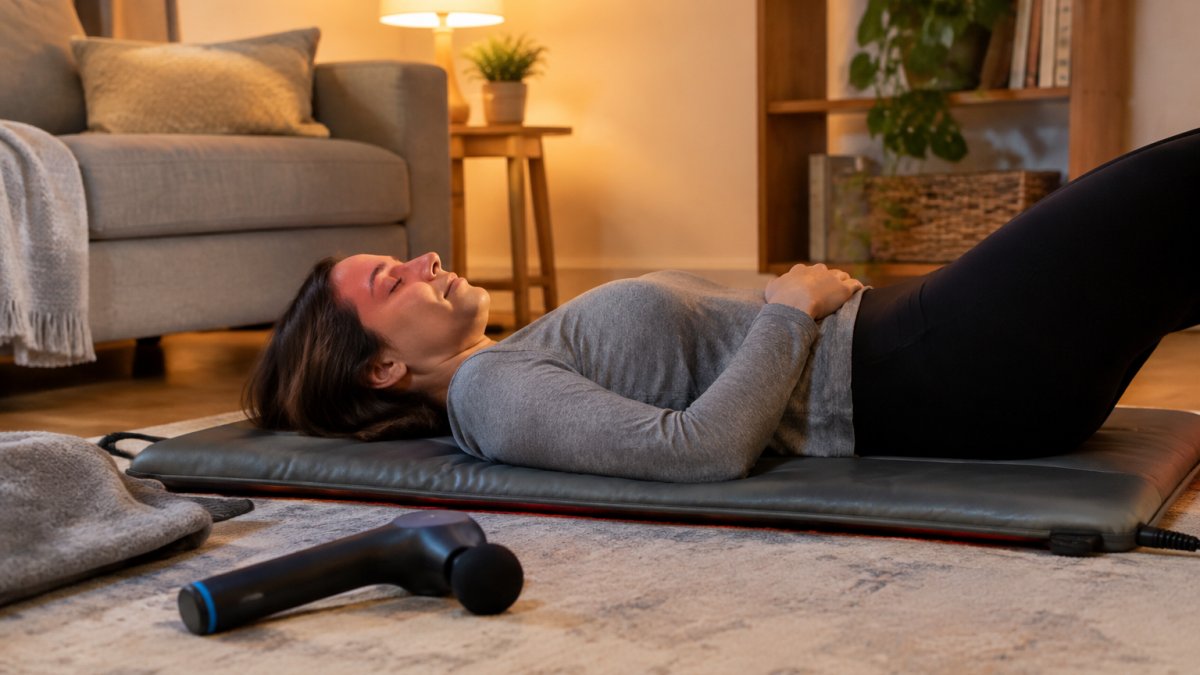
Match the device to the job. For broad areas, the heated Thermo-Cyclopad ($1,899.00) combines heat with cycloid massage across a large surface. For a single stubborn spot, the Handheld Cyclo-Therapy Unit ($899.00) delivers concentrated treatment you can direct precisely.
If you want both, the Complete Therapy Set bundle pairs the pad and handheld unit at $2,798.00, covering full-body and targeted work in one purchase. For lower-back comfort specifically, the Comfort Ease Therapy Device ($469.00) offers heat and five massage programs in a portable cushion.

Best for: anyone building a home recovery routine that covers both broad areas and specific trouble spots. Skip if: you only need occasional relief in one small area and want the simplest possible setup.
Frequently Asked Questions
Is vibration therapy good for muscle recovery?
Vibration therapy can support muscle recovery by increasing local circulation, reducing soreness, and helping muscles relax after exertion. It works best as part of a broader recovery routine that includes hydration, sleep, and gentle stretching. Anyone with a medical condition should check with a clinician before starting.
How long should you use a vibration therapy device for muscle recovery?
Most recovery sessions run 10 to 20 minutes per muscle group, once or twice a day. For post-exercise soreness, a 15-minute session shortly after activity is a common starting point. Longer is not automatically better: extended sessions can leave muscles feeling fatigued rather than refreshed. Start with 10 minutes, note how your body responds, and adjust from there.
How does cycloidal vibration therapy differ from vibration plate training?
A vibration plate is a platform you stand on, and it is typically used for training and balance work. Cycloidal vibration therapy uses a pad or handheld unit that applies controlled three-dimensional cycloid motion directly to a targeted area, such as a sore back, shoulder, or leg. That makes cycloidal devices better suited to localized recovery and joint comfort, while plates are more about whole-body training stimulus.
What are the risks or side effects of vibration therapy?
Most people tolerate vibration therapy well. Some feel mild dizziness, tingling, or temporary muscle fatigue after a session. Speak with a doctor before use if you have a medical condition or are pregnant. Stop and seek advice if you feel pain, numbness, or unusual symptoms.
Can vibration therapy help with muscle soreness after exercise?
It pairs well with light stretching and adequate sleep. Use it as a recovery aid rather than a replacement for rest, and keep sessions short, around 10 to 20 minutes.
What does research say about cycloidal vibration therapy and muscle recovery?
Treat claims with appropriate caution, and judge results by how your own body responds over a few weeks of consistent use.
Recovery rarely comes from a single intervention, and the people who get the most from vibration therapy are the ones who use it consistently alongside movement and rest. If you're ready to build that routine, Niagarassage offers clinic-quality, drug-free cyclo-therapy devices with proprietary cycloidal vibration technology, portable designs, and heated options that make daily sessions easy to keep. Get started with Niagarassage and give your muscles the consistent support they need to recover.


Also in News


Best Non-Pharmacological Sleep Aids for Seniors: A Comparison


Is Muscle Soreness After Knee Surgery Normal?

